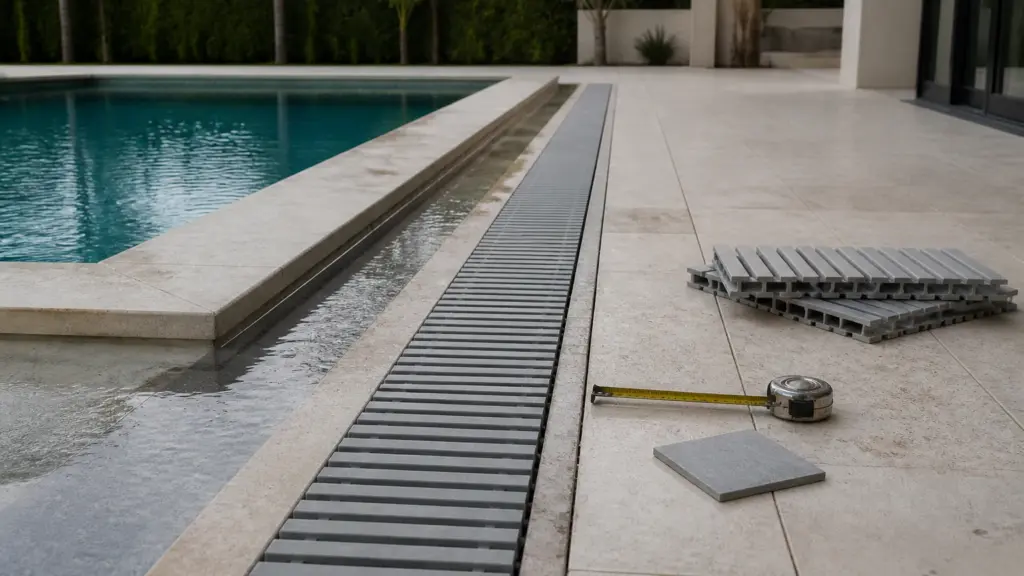
What is the grating along a pool edge supposed to do, and will the one you are considering actually do it? Many owners treat it as a finishing detail chosen late, after the coping and tiles are settled. In practice it is a drainage part, a walking surface and a visible design line all at once. Reviewing a few points beforehand prevents mismatches that are awkward to correct once the channel is built.
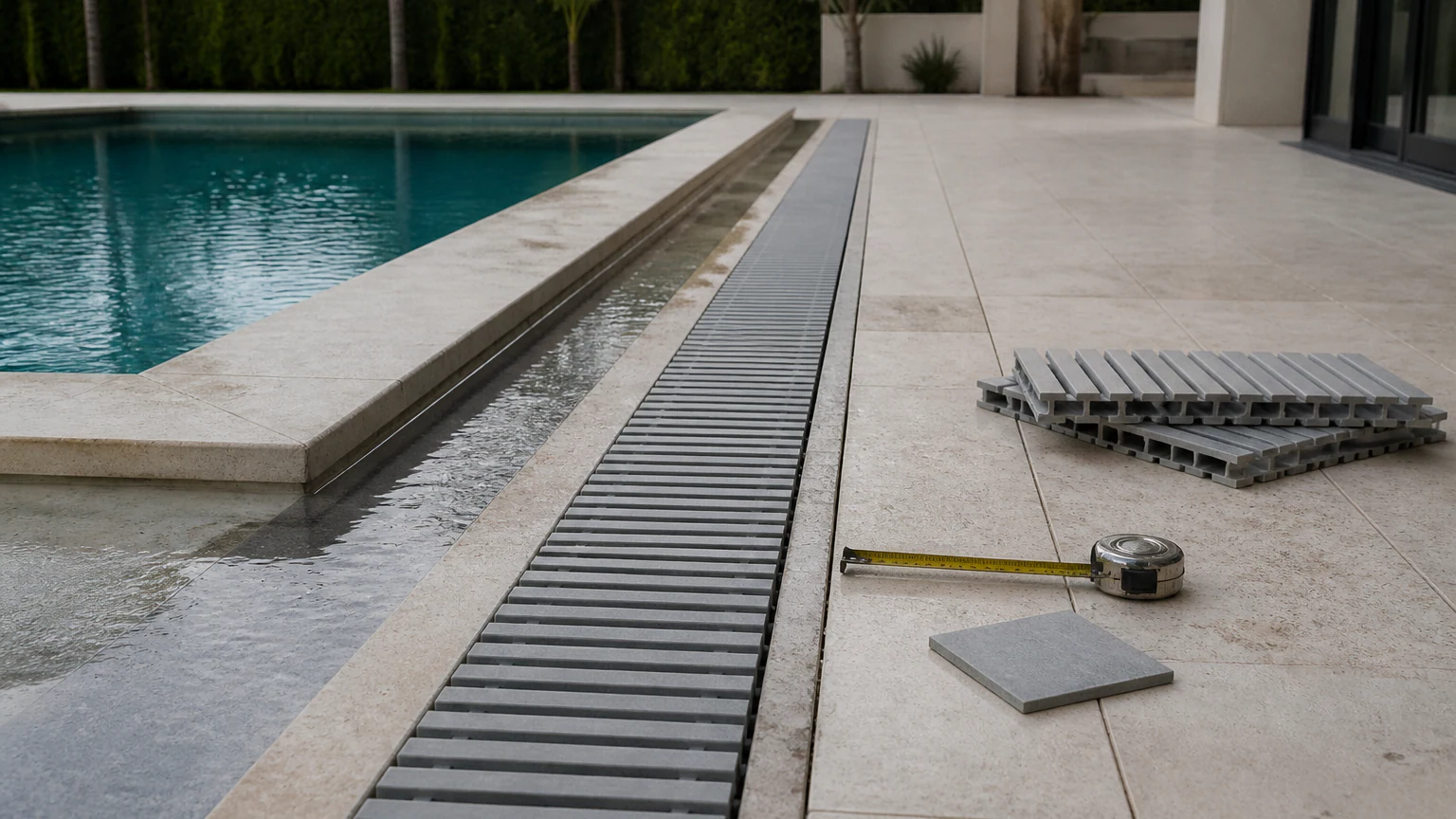
The first check is the system the grating belongs to. In an overflow pool, water spills across the edge into a channel and returns to the balance tank, and the cover over that channel is what most people call pool grating. It has to let water through while carrying bare feet safely. Because it runs along the whole perimeter, it is also one of the most visible parts of the finished pool.
For readers in coastal Balıkesir towns, where holiday houses and small hotels often add pools, this detail matters because seasonal use is heavy and repairs are inconvenient. A grating that does not suit the channel is noticed by every guest and is tedious to replace. Thinking about it at the planning stage costs very little. Thinking about it after tiling can mean cutting into finished work along the entire edge.
Second, match the type to the pool shape. A rigid monoblock piece, commonly about 65 cm long, suits straight sides. Oval or curved pools usually call for flexible grating, which in porcelain ranges typically has a steel wire core inside so the pieces can follow a gentle radius. A hidden-slot design suits a minimalist edge, because the drainage opening is tucked out of sight rather than shown as a visible gap.
Third, confirm the channel width before anything else is priced or ordered. Porcelain grating is sold in several widths, and the range described on Poolarch’s own guide runs from 15×50 cm up to 30×65 cm. A piece that is a few millimetres too wide will not seat properly, while one that is too narrow leaves gaps. The channel should be measured on site and checked against the supplier’s technical sheet.
Quantity is the fourth point, and it is simple arithmetic that is often skipped. Divide the length of the channel by the length of one piece, then count the corners and any curved sections separately, since they rarely use full pieces. Rounding up is sensible, and a few spare pieces cover cuts and breakage. Ordering a second batch later risks a slight difference in tone.
Surface and material deserve a careful look as well. The grating will face chlorinated water, strong sun and wet bare feet every day, so porcelain bodies with low water absorption are a common choice. Some products are described as anti-bacterial; the wording of such claims is worth reading closely. Grip should be considered together with the surrounding terrace, because a safe edge depends on both surfaces working in the same way.
Colour and finish come next. The grating sits beside the coping stones and the pool lining, so a mismatch in tone shows clearly against a continuous line. Natural light changes how grey or beige surfaces appear, which is why viewing a physical sample outdoors is more reliable than judging from a catalogue photograph. Matching the grating with the coping at the sample stage avoids disappointment once everything is installed.
Supply details form the sixth group of questions. Poolarch, a company selling porcelain pool ceramics and related parts, presents grating alongside handles and anti-slip terrace tiles, which shows how these items are often bought together. Whichever supplier is used, it helps to ask about stock levels, sample availability and whether the same batch can cover the full order. Written confirmation of dimensions removes most later disputes.
Taken together, these checks turn a vague purchase into a short, orderly list: system, shape, channel width, quantity, surface, colour and supply. None of them is difficult, but each is cheaper to resolve on paper than at the pool edge. A buyer who has answered them can compare products on equal terms. The grating then does what it is meant to do quietly and for many seasons.
Link: https://www.poolarch.com